Need Emergency Fuel Delivery?
  info@elanfuels.com
Key Takeaways
- How much fuel does a plane hold varies from under 100 gallons in small trainers to more than 60000 gallons in large long haul jets.
- Fuel is stored in multiple tanks to protect stability, structure and safety.
- Actual usable fuel is lower than design airplane fuel tank capacity because of safety margins.
- Jet fuel and aviation gasoline are different from car plane gas and follow strict standards.
- Fuel weight, burn rate and reserves all control how far an aircraft can fly and how many passengers it can carry.
Table of Contents
How Much Fuel Does A Plane Hold?
Plane fuel capacity, varying by aircraft type and mission, is a common interest due to the huge amounts involved compared to cars. A small Cessna trainer holds 50-60 gallons, while large business jets hold thousands. Widebody airliners can exceed 50000 gallons. This is the design capacity, the usable fuel is slightly less as some remains in the system. Commercial planes typically hold 5000-60000 gallons. Midsize private jets have a tank capacity of 1000- 2500 gallons, with large long-range business jets exceeding 4500 gallons.
To know more about average plane capacity explore professional aircraft databases or flight cost calculators to compare exact tank sizes and range for different models.
What’s The Difference Between Gas And Jet Fuel In Planes?
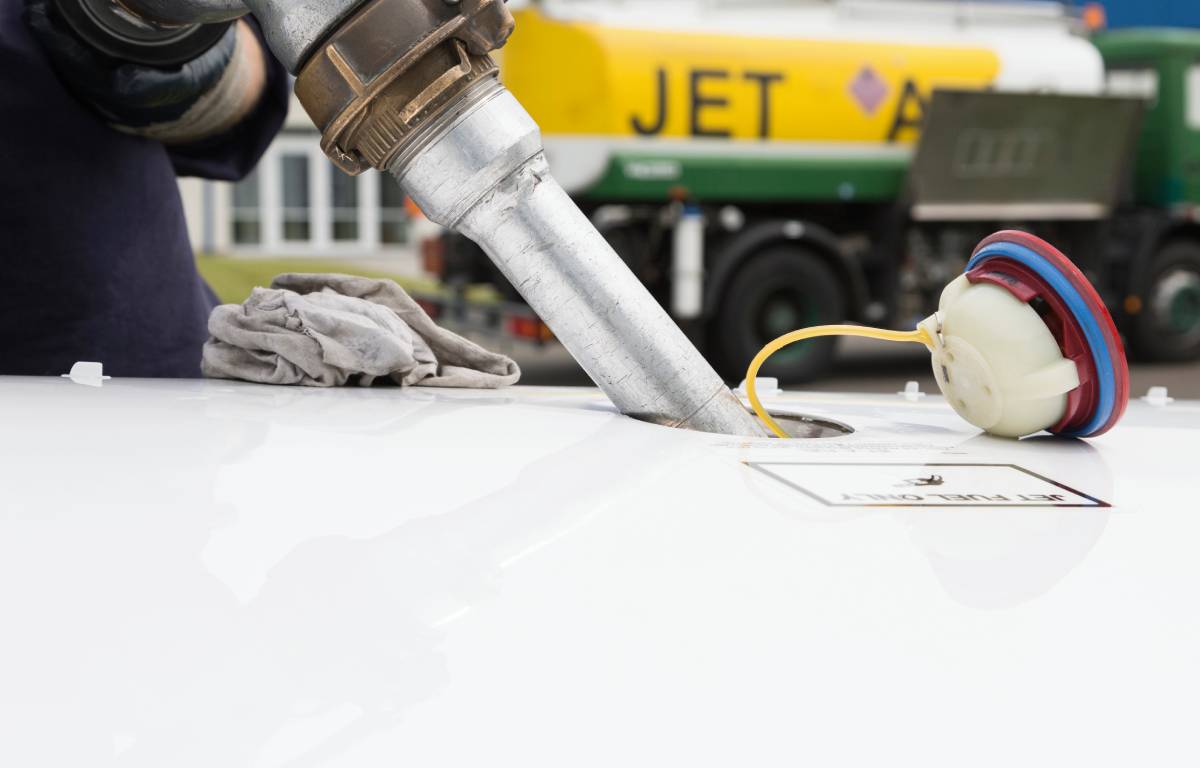
The term “gas” in aviation is confusing. It usually refers to AvGas (aviation gasoline) for small piston aircraft, which is different from car fuel. Turbine aircrafts, like commercial jets, use kerosene-based jet fuels such as Jet A or Jet A1. Questions about “plane gas” usually concern the amount of jet fuel used, not car gasoline, as commercial jets do not run on road fuel. AvGas and jet fuel are distinct energy sources designed for different engines and flight conditions.
Struggling To Estimate How Much Fuel A Plane Holds And Costs To Fill?
You have seen how fuel capacity jumps from small piston aircraft to widebody jets and how a full tank can cost anywhere from hundreds to six figures. Get a simple way to plug in your aircraft type, typical fuel price and tank size so you can see a realistic fuel bill before every trip.
What Is The Average Fuel Tank Capacity Of An Airplane?
Fuel is stored in multiple tanks (wing, center, and auxiliary) to manage structure and balance, collectively defining the airplane fuel tank capacity. Engineers must maintain the aircraft’s center of gravity. Fuel is typically burned from the center tank first, then wing tanks, to keep weight central. This design impacts how many gallons an airplane holds, as optional auxiliary tanks increase capacity but add weight too, potentially reducing payload.
How Much Fuel Does A Plane Use?
The amount of fuel an aircraft consumes, including the fuel consumption rate per hour and the total fuel used on long flights, is a common question. The fuel usage varies significantly across the different phases of a flight:
- Takeoff and Climb: This is the phase of maximum fuel burn, as engine thrust settings are near their peak. A typical single-aisle jet can use several hundred gallons of fuel within the initial 15-20 minutes.
- Cruise: Once at an efficient altitude, engine power is reduced. A mid-sized jet will typically burn between 700-1000 gallons per hour, while large, long-range widebody aircraft can consume several thousand gallons per hour.
- Descent and Landing: Fuel burn decreases considerably as engine thrust is much lower. This phase is short, so the total fuel consumed is minor compared to the cruise portion of the flight.
Overall, an airplane’s total fuel consumption is dependent on variables such as its weight, altitude, speed, and wind conditions. For extended journeys, the jet fuel consumption per mile often improves because the high-burn takeoff and descent phases represent a smaller fraction of the total trip.
Want To Plan Flight Range Around Fuel Capacity And Reserves With Confidence?
This guide showed how fuel tank layouts, reserve rules and payload limits all shape how far an aircraft can fly safely. Use a clear planning checklist to match tank capacity, alternate airports and contingency fuel so you can design routes that stay within safe margins while avoiding unnecessary extra weight.
How Much Fuel Does A Jet Use?
Modern jet engines are better designed than older ones. They are far more efficient because they squeeze a lot of air and mix it exactly right with fuel. This lets today’s jets fly long distances without using as much fuel.
Engineers have improved how much fuel is burned for the power produced (specific fuel consumption) by using new materials and large bypass fans. So, even though planes are bigger now, the amount of fuel needed per passenger has actually gone down over time. Airlines are still really focused on the environmental impact. For long flights, they are trying to save fuel by adding small wing extensions, using lighter materials, and planning smarter routes. Many companies are also testing sustainable fuel mixes. This lets them cut down on emissions without having to make big changes to the engines themselves.
How Much Fuel Does A 737 Hold?
Many travelers want to know how much fuel does a 737 hold because it is one of the most common airliners while fuel capacity varies by generation and model, typical usable capacities are:
- 737 Classic series, around 5300- 6000 gallons.
- 737 Next Generation, often about 6875 gallons.
- 737 MAX, around 6300- 6900 gallons depending on variant.
These numbers help answer how many gallons of fuel does a 737 hold and how much fuel does a Boeing 737 hold for planning purposes. For more detailed planning, airlines also look at how many gallons of jet fuel does a 737 hold when auxiliary tanks are installed on special versions.
Fuel capacity links directly to range and payload. More fuel allows longer trips but limits how many passengers or how much cargo can be carried at maximum takeoff weight. This balance explains why route planners care about both tank size and runway length when they use 737 aircraft.
How Much Fuel Does A 747 Hold?
The Boeing 747 is known for its very large fuel capacity. A 747-400 holds about 57000 gallons, while the newer 747-8 can carry over 60000 gallons. These tanks are located in the wings, center wing box, and body, enabling long intercontinental flights with large passenger loads. The 747’s capacity is among the largest for commercial passenger jets. Its sophisticated fuel system manages multiple pumps, crossfeed valves, and controls to maintain the center of gravity during long flights.
How Much Does It Cost To Fill Up A Plane?
Fuel is a major operating cost. Prices vary with airport, region and global oil markets. Here is a simplified breakdown of aircraft fuel capacity and associated costs
| Aircraft Type | Fuel Capacity Range | Estimated Cost of a Full Tank |
|---|---|---|
| Small Piston Aircraft | 40-80 gallons | A few hundred dollars (based on typical AvGas prices) |
| Midsize Business Jet | 1500-2500 gallons | Tens of thousands of dollars |
| Narrow-Body Airliner | 5000-8000 gallons (for a long sector) | Tens of thousands of dollars, sometimes more, depending on current fuel prices |
| Large Widebody Jet | 30000-over 50000 gallons | Well into six figures (in dollars) for a full international uplift |
These substantial differences in fuel requirements are why airlines actively manage fuel costs through hedging, applying surcharges, and continuously monitoring fuel consumption on every route.

How Much Does Jet Fuel Weigh?
Fuel weight is a crucial factor in flight planning. Pilots and dispatchers must determine the weight of jet fuel to accurately calculate performance and set payload limits.
Typically, jet fuel weighs approximately 6.5-7lbs per U.S. gallon, which translates to about 0.8kg per liter. Consequently, a full long-haul fuel load exceeding 50,000 gallons can add over 300,000lbs to the aircraft’s total weight. When planning, fuel weight is determined by converting the volume (gallons or liters) into mass (pounds or kilograms). Additionally, airlines closely monitor how changes in temperature affect fuel density. Cooler fuel is denser, meaning the same volume weighs more, which directly impacts the aircraft’s takeoff performance.
How Much Fuel Does A Plane Use To Take Off?
Takeoff is one of the most fuel-intensive flight phases. A single-aisle jet can burn hundreds of gallons from engine start to cruise. Takeoff and initial climb may consume 5-10% of total trip fuel on a medium flight, with heavy long-haul aircraft burning even more due to high weight. Airlines mitigate this by using reduced-thrust takeoffs when possible, minimizing early-phase fuel use while maintaining safety.
How Much Reserve Fuel Do Planes Carry?
Aircraft fuel requirements are mandated by regulations to include reserves and contingency amounts, allowing pilots to manage potential delays and diversions. The main categories of reserve fuel include
- Contingency fuel to cover forecast uncertainty, such as stronger headwinds.
- Alternate fuel to reach another airport if the destination becomes unavailable.
- Final reserve fuel, often defined as a fixed time of holding at low altitude.
- Extra discretionary fuel added by the commander when conditions seem uncertain.
This explains why people ask how much extra fuel do planes carry. Even if arrivals are on time, aircraft still land with usable reserves. This leftover amount connects directly to safety margins and to the next section about fuel after landing.
How Much Fuel Is Left After Landing On Commercial Flights?
A commercial airliner’s fuel capacity, or “how many gallons of fuel does a plane hold,” is a fixed design specification. However, the actual amount of fuel carried and the amount remaining after landing varies for every flight. Commercial flights are not permitted to land with almost empty tanks. They must maintain a mandatory final reserve fuel, in addition to any required contingency and alternate fuel amounts. After a flight, the remaining fuel can often be factored into the fuel load for the subsequent sector, provided the schedule and route permit it. Dispatchers meticulously recalculate the fuel load to ensure that the combination of existing and newly added fuel adheres to all regulations. Airlines closely monitor these fuel patterns. Their goal is to avoid carrying unnecessary fuel weight which increases operating costs while still guaranteeing a robust safety margin.
What Fuel Do Planes Use?
In the table below you can see what type of planes use which types of fuel linking fuel type with storage conditions, showing that aviation fuels must be managed carefully, especially gasoline based products.
| Fuel type | Typical aircraft use | Approx storage life in sealed container | Notes on storage conditions for gasoline or aviation fuel |
|---|---|---|---|
| AvGas 100LL aviation gasoline | Piston training and touring aircraft | Often up to 1 year in a cool dry place | Protect from water and heat to keep gasoline stable and prevent gum formation |
| Jet A or Jet A1 | Turbine aircraft and airlines | Around 1 year in clean tanks under good conditions | Keep free of water and contaminants to avoid microbial growth and filter blockages |
| Road gasoline not used in certified aircraft | Not approved for most certified aircraft | Varies but often a few months before quality degrades | More sensitive to oxidation and ethanol effects, so storage time is shorter in most gasoline situations |
Curious How Plane Fuel Capacity Affects Efficiency And MPG Per Passenger?
You learned that modern jets can reach 70 to 100 miles per gallon per passenger when fuel use is spread across many seats. Compare typical fuel burn and capacity for different aircraft so you can understand per passenger impact and choose more efficient aircraft or routes when possible.
How Long Does It Take To Fuel A Plane?
Ground teams often get questions about how long it takes to fuel an airplane before departure. The time depends on aircraft size, fueling method, and safety checks. Small aircraft can be filled in a few minutes. Airliners take longer, a narrow body might need 15-30 minutes, while large widebodies can require 30 minutes or more. Strict safety procedures are followed during this time. Careful planning ensures that total uplift matches the flight plan plus reserves, keeping turn times low.
What Is The MPG (Miles Per Gallon) Of A Plane?
Comparing a plane’s miles per gallon (MPG) to a car’s is misleading; a better metric is miles per gallon per passenger. A modern single-aisle jet typically achieves 70-100 MPG per passenger. Large, full long-haul aircraft can also be efficient due to shared fuel burn. Therefore, plane fuel capacity and usage must be considered alongside passenger count. Per seat, modern jets can surpass the efficiency of many single-occupant cars on short trips. It is advisable to find eco-friendly flight options, like newer aircraft and sustainable aviation fuel programs, by comparing per-passenger emissions through trusted aviation resources.